

You’ve probably seen e-collars (or “shock collars”) online or at the park and wondered two things:
- Do they actually work?
- Are they safe and fair for your dog?
You’re not alone. Many caring dog owners end up here after struggling with recall, chasing wildlife, or big feelings in public spaces. You want better behavior, but you don’t want to scare or hurt your dog.
This guide walks you through dog training with an e-collar in a balanced, honest way: what they do, what the science says, when they might be considered, and how to keep things as humane as possible if you choose to use one.
We’ll also talk about something most e-collar manuals barely mention: what to put in place before you ever turn the collar on.
Understanding E-Collars And How They Work
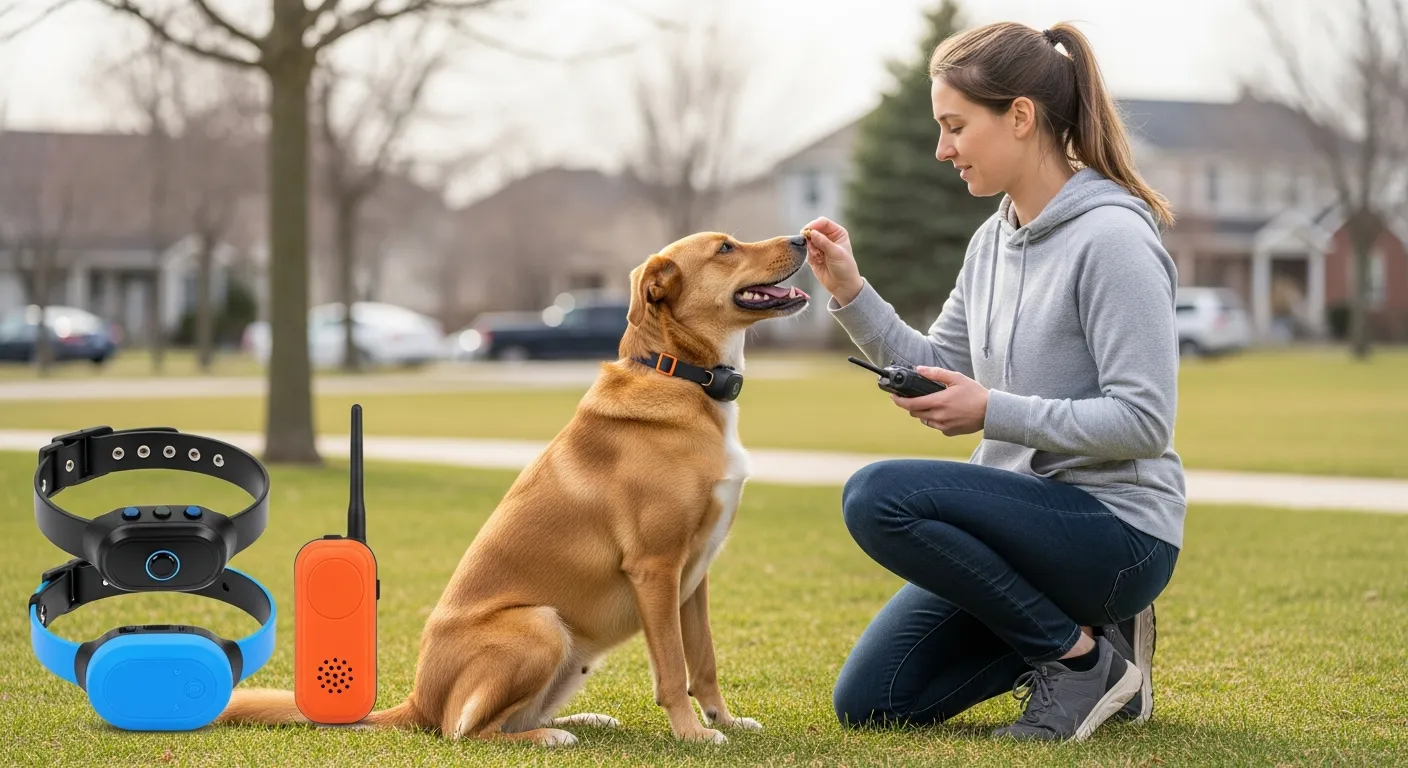
At the most basic level, an e-collar is a remote-controlled collar that lets you send a:
- small electrical stimulation (static)
- vibration
- sound (tone or beep)
The idea is to interrupt a behavior or add pressure the dog learns to turn off by doing the right thing (for example, coming when called).
Most modern trainers who use these talk about “low-level stimulation,” not big painful shocks. But even low levels can be unpleasant or confusing for a dog, especially if the groundwork isn’t there.
Research from groups like the UK’s Universities Federation for Animal Welfare and position statements from the American Veterinary Society of Animal Behavior (AVSAB) say something important: e-collars don’t outperform reward-based methods for obedience or recall, and they carry more welfare risks (stress, fear, and anxiety).
So think of an e-collar as an optional, specialized tool, not a magic fix or a shortcut.
Types Of E-Collars And What They Are (And Are Not) For
You’ll usually see three main types:
- Static (“shock”) collars
Deliver adjustable electrical pulses. Good ones offer lots of levels, so you can find the lowest possible working level. These are the most controversial and the ones you need to be the most careful with.
- Vibration collars
Use buzzing or vibration instead of static. Some people use them for deaf dogs or as a mild attention-getter. They can still be startling.
- Tone / beep collars
Play a sound your dog can learn to associate with a cue (like recall) or as a warning before another sensation.
What they are not for:
- punishing a dog for growling or being scared
- “fixing” aggression on their own
- using on totally untrained dogs as your first training method
- leaving on your dog 24/7
They’re designed as remote communication tools, not “zap them when they’re bad” devices.
Pros, Limits, And When An E-Collar Might Be Considered
People who like e-collars often say they help with:
- off-leash reliability at distance (especially with prey-driven dogs)
- interrupting dangerous behaviors (chasing cars, livestock, wildlife)
- giving clear, consistent feedback outdoors when a leash or long line feels limiting
There are case reports of owners seeing less chasing or nuisance barking after careful, structured e-collar programs.
But here are the big limits:
- Studies comparing e-collars to positive reinforcement training find no real advantage in speed or results for common things like recall and basic obedience.
- Dogs trained with aversive tools show more signs of stress and fear (lip-licking, lowered posture, tense body language).
- Many behavior pros end up treating problems that started because an e-collar was used too early or too harshly.
So, when might you even consider one?
- You’ve already put solid work into reward-based training, and your dog understands the behaviors involved.
- You’re dealing with real safety concerns (bolting toward roads, chasing livestock, or wildlife) and have tried long lines, management, and positive recall training first.
- You’re willing to work with a qualified trainer who uses the lowest effective levels and emphasizes your dog’s emotional welfare.
If you’re hoping an e-collar will fix everything in a weekend with no training on your end, it’s almost guaranteed to backfire.
Safety, Ethics, And Legal Considerations

Before you add any kind of remote collar, it’s worth stepping back and asking:
“Is this the kindest, safest option for my particular dog?”
Welfare And Ethical Concerns You Should Weigh
Research and position papers from organizations like AVSAB and many European veterinary groups highlight several concerns:
- Increased stress and fear
Dogs trained with aversive tools (including e-collars) show more stress signals: yawning, lip-licking, tension, and avoidance.
- Association mistakes
Your dog may link the stimulation to the wrong thing: kids nearby, other dogs, or the environment itself. That can actually create reactivity or fear.
- Risk to your bond
If your dog feels that being near you or coming toward you sometimes predicts discomfort, that can erode trust.
In contrast, reward-based methods (treats, toys, praise, play) have strong evidence for:
- improving obedience
- protecting welfare
- strengthening the dog-owner relationship
That’s why many veterinary behaviorists recommend exhausting non-aversive options first. It’s not about being “soft:” it’s about long-term mental health and trust.
Checking Local Laws And Professional Guidelines
Depending on where you live, e-collars may be restricted or banned:
- Some parts of Europe (including Scotland and regions of the UK) have regulations or outright bans on certain electronic collars.
- Other countries are actively debating new rules based on welfare data.
Before buying anything, check:
- your national or state/provincial laws
- local animal welfare regulations
Also look at guidance from:
- AVSAB (American Veterinary Society of Animal Behavior)
- Royal Society for the Prevention of Cruelty to Animals (RSPCA)
- your own vet or a board-certified veterinary behaviorist
If the consensus in your area is strongly against e-collars, that’s important information to include in your decision.
Foundations Before You Ever Turn The E-Collar On
If there’s one thing to remember, it’s this:
An e-collar should never be your dog’s first language.
You want your dog to already understand what you’re asking, and to have a history of being rewarded for doing it.
Physical And Emotional Readiness: Is Your Dog A Good Candidate?
An e-collar is not a good fit for:
- very fearful or anxious dogs
- dogs with a history of trauma or harsh punishment
- puppies without basic training
You might cautiously consider one if:
- your dog is physically healthy (a vet check is smart if you’re unsure)
- you’ve already worked on basics with food and praise
- your dog recovers quickly from mild surprises and isn’t overly sensitive
If your dog already startles easily, shuts down, or becomes reactive when confused, an e-collar is more likely to make things worse.
Essential Pre-Training: Name Recognition, Recall, And Marker Words
Before electronics enter the picture, spend time on:
- Name recognition – Say their name, and when they look at you, reward. You want that reflexive “What’s up?” response.
- Recall – Start on a long line: say your cue (“Rover, come.”), encourage with happy body language, reward heavily when they reach you.
- Marker word or clicker – A simple word like “Yes.” or a clicker that always means, you just did the right thing and a reward is coming.
You want these skills working fairly well in low-distraction spaces. Your dog should already think, “Listening to you usually pays off.”
Choosing And Fitting An E-Collar Correctly
If you do go ahead:
- pick a collar with many small levels of adjustment
- avoid cheap no-name devices that may be inconsistent
- read the manual front to back (yes, really)
For fitting:
- Place it high on the neck, usually just below the ears.
- The contact points should touch the skin, but you should still be able to slide two fingers underneath.
- Rotate the collar’s position regularly to avoid skin irritation.
Never leave the collar on for long periods (most manufacturers recommend no more than 8–10 hours a day, often less). And don’t stack it with tight martingales or prong collars in the same area.
Step-By-Step: Introducing Your Dog To An E-Collar
When you first bring the collar home, it shouldn’t mean “Uh oh, I’m in trouble.” It should feel as boring and neutral as any other harness or gear.
Finding The Right Working Level (Without Frightening Your Dog)
You’ll often hear about the “working level” – the lowest level your dog can just barely notice.
A careful approach:
- Put the collar on without turning it on for several days during normal activities so your dog gets used to the feel.
- In a calm setting, turn it on at the lowest level.
- Gradually increase by one level at a time while your dog is distracted by something pleasant (like sniffing or light play).
- Watch for very subtle signs they notice it:
- an ear twitch
- brief head turn
- slight pause in what they’re doing
You don’t want:
- yelping
- jumping away
- looking scared or confused
If that happens, you’ve gone too high. Stop, give a break, and reassess your plan with a trainer.
Pairing Sensation With Cues And Rewards
Once you’ve found a gentle working level, you want the collar to become part of a clear pattern:
Sensation → Dog performs known behavior → Reward arrives
For example, with recall on a long line:
- Say your recall cue (“Rover, come.”).
- If they hesitate, apply a very low stimulation while guiding with the long line.
- The moment they commit to coming toward you, release the stimulation.
- When they reach you, mark (“Yes.”) and reward with treats, praise, or play.
The goal is for your dog to learn: “If I listen, the feeling stops and good things happen.” The reward is just as, if not more, important than the collar.
Short, Calm Sessions And Reading Your Dog’s Body Language
Keep early sessions:
- short (5–10 minutes)
- simple (one or two behaviors only)
- in low-distraction settings
Watch for:
- loose body, waggy or neutral tail
- normal breathing
- willingness to take food and engage
Red flags include:
- tucked tail
- refusal to move or explore
- panting, whining, or frantic behavior
- refusing food they’d normally love
If you see these, stop the session, remove the collar, and go back to basics with positive reinforcement only. It’s better to move slowly than rush and create fear.
Common Training Goals With E-Collars (And How To Do Them Humanely)
Not every behavior is a good candidate for e-collar work. But some owners and trainers do use them for:
Improving Recall And Off-Leash Reliability
Recall is probably the most common reason people look into dog training with an e-collar.
A humane recall plan might look like:
- Teach recall first with long line, food, and games (like “chase me” and treat parties when they catch you).
- Add the e-collar later as a gentle back-up cue when distractions are higher.
- Always pair recall with big rewards – think multiple treats, a game of tug, or being released back to sniff afterward.
Even with an e-collar, you still want:
- fenced areas or safe open spaces
- a long line when you’re not 100% sure
Technology doesn’t replace safety.
Reducing Jumping, Counter-Surfing, And Other Manners Issues
For manners issues, you usually get farther faster by:
- managing the environment (no food on low counters, baby gates, leashes indoors)
- teaching an incompatible behavior (sit for greetings instead of jumping, go to mat instead of surfing)
If an e-collar is used at all for these, it should only be once your dog clearly understands the polite behavior and you’re using the collar to remind, not punish.
Example: Your dog knows “Off” and “Go to your bed.” In a supervised session:
- Dog jumps toward the counter.
- You give the verbal cue (“Off, bed”) along with a light stimulation.
- As soon as they step away and move toward their bed, you stop the stimulation and reward at the bed.
If your dog looks confused or stressed, you’re better off pausing all e-collar work and going back to reward-based practice.
Using An E-Collar Around Distractions And In Public Spaces
Public spaces add layers: kids, bikes, other dogs, smells, and noise. For many dogs, that’s already stressful.
If you’re going to use an e-collar outside:
- Proof the behavior indoors and in your yard first.
- Start in quiet areas before moving to busy parks.
- Keep sessions short: end on a win.
And remember: in many cities, leash laws still apply, e-collar or not. Off-leash freedom is a privilege, not a right, and it should never put other people or dogs at risk.
.Dog practicing recall outdoors with a long line and e-collar, owner kneeling and rewarding
Mistakes To Avoid And Trouble Signs To Watch For
A lot of horror stories around e-collars start with simple, very human mistakes. No judgment, just things to avoid.
Common Handler Errors That Confuse Or Scare Dogs
- Using high levels right away
Jumping to strong static “so they really feel it” is more likely to create panic than learning.
- Bad timing
Pressing the button after the behavior is already over means your dog learns…nothing helpful. Or worse, they associate it with something totally different.
- No clear training plan
Random zaps with no cues, no pattern, and no rewards just feel like unpredictable punishment.
- Relying only on the collar
An e-collar doesn’t replace management, enrichment, exercise, or medication for serious anxiety.
Behavior Red Flags: When To Stop And Get Professional Help
Hit pause and talk to your vet or a qualified behavior professional if you see:
- new or worsening growling, snapping, or biting
- your dog avoiding you or hiding when the collar comes out
- shutdown behavior (frozen posture, refusing to move)
- big changes in appetite, sleep, or overall mood
These are signs your dog is not coping well, and continuing with the collar could damage both welfare and trust.
Working With A Qualified Trainer Or Behavior Professional
If you decide to use an e-collar, getting expert eyes on your dog is one of the kindest things you can do.
Look for:
- trainers who are transparent about methods and open to reward-based approaches
- certifications or ongoing education (CPDT, KPA, IAABC, or vet behaviorists)
- people who ask about your dog’s medical history, fear levels, and environment, not just the “bad behavior”
If someone suggests high levels, punishing growling, or using the collar on a fearful dog, that’s a good sign to keep looking.
Conclusion
Dog training with an e-collar sits in a gray, emotionally charged area, and it makes sense that you’d want clear, honest information.
Here’s the bottom line:
- E-collars aren’t necessary for most dogs, and research doesn’t show them beating good positive reinforcement training.
- They can increase stress and risk harming your bond if used too early, too hard, or without a plan.
- If you choose to use one, you’ll want:
- solid foundations (name, recall, marker word) already trained with rewards
- a very low working level and careful, consistent timing
- short, calm sessions and close attention to body language
- guidance from a trainer who genuinely prioritizes welfare
If you’re feeling stuck with your dog’s behavior, it’s completely okay to start by doubling down on the basics: more structured exercise, enrichment, clear routines, and positive training sessions. Those alone transform many dogs.
And if you’re ever unsure whether an e-collar is right for your situation, a chat with your veterinarian or a force-free behavior professional can help you sort through the options in a way that keeps both safety and your dog’s happiness front and center.